|
الصفحة 5 من 10 KUFR-QASSEM MASSACRE October 29, the Arab population in Israel and democratic Jewish circles commemorate the anniversary of the Kufr-Qassem massacre. On this date in 1956, Israel opened its aggression concocted with the British and French imperialist powers which attempted in vain to regain their rule over the nationalized Egyptian Suez Channel by military means, under the pretext of allegedly driving a "neutral" wedge between the Egyptian and the Israeli armies along the Channel. Well, the Egyptians succeeded to defeat the whole invading British and French troops and Israel had to withdraw a few months later (April/May 1957) from the Sinai Peninsula and the Gaza Strip it conquered. At that time, from 1948 to 1965, all towns, villages and other rural localities in Israel with a population of Arab citizens, foremost in the northern Galilee and the central Triangle districts were kept under strict military rule. On this particular day of starting the aggressive war, all these areas were put under curfew, although they are quite far away from the attacked Gaza Strip and the Sinai Peninsula. Nowhere, however, outstanding incidents or clashes occurred. The only exception was a horrible blood bath, Israeli "security forces" committed at the entrance of the then still small village of Kufr-Qassem, less than 20 miles east of Tel-Aviv.
When villagers, returning from work in the fields or the near-by Petah-Tiqva industrial area, having been unaware of the curfew, arrived at a road bloc, the Israeli army had set up near the entrance to the village, their vehicles, lorries, cars, or horse-driven wagons, were stopped by an Israeli army unit and forced to descend from the vehicles. All were taken to the roadside and shot without further warning. 49 villagers, among them elderly and young men, boys, women and girls, one of the women in the eighth month of pregnancy, were shot dead, and only a few accidentally survived seriously wounded, some of them buried under the dead bodies of others. At first, the whole affair was kept strictly concealed from the public eye by the sharp censorship. However, a young Israeli journalist, fluent in the Arabic language, Latif Dori, a correspondent of the organ of the United Workers' Party Mapam, which at the time was a coalition partner in the Labor led Ben-Gurion Government, got wind of the horrible affair. He succeeded to enter Kufr-Qassem illegally in spite of the curfew a few days after the event. At a press conference, held last week in Tel-Aviv by the Arab-Jewish Solidarity Committee with Kufr-Qassem towards the 40th anniversary, Dori stressed that the reports, he at the time heard in the village, made his hair stand on end. He tried to mobilize leading figures from his party, among them cabinet ministers and Knesset members, but these rejected any attempt to break the plot of hushing up the crime. Dori then turned to two communist Knesset members, Tawfiq Toubi and Meir Vilner. Together with Dori they visited the wounded survivors, kept under close police detention in a Jewish hospital near Petah-Tiqva and listened to their eyewitness reports. MKs Toubi and Vilner turned to the then PM and Defense Minister Ben-Gurion, as well as to the Knesset Presidium to protest and to raise the matter in the Knesset with the intention to set up a neutral public investigation committee, as well as demanding that the officers, responsible for the massacre be put on trial.
When Ben-Gurion and the Knesset bodies refused to act, the communist Knesset members published a pamphlet, relating the blood-curling story of the massacre together with all those eyewitness reports, they heard in the Beilinson hospital. The pamphlet was sent to several thousand personalities, politicians, academics, journalists and trade union leaders. Uri Avneri, then the publisher and editor of the weekly magazine "Olam Haze" popular mainly among the younger generation, today the leading figure in the Gush-Shalom peace bloc, broke the censorship and published the whole story. With this, the taboo about the Kufr-Qassem blood bath was lifted. The government was forced by the public uproar about the affair to bring charges before a military court against the army officers and NCOs responsible for the crime.
In the verdict, convicting the perpetrators of the Kufr-Qassem massacre, District Judge Benjamin Halevy, inter alia ruled, that the claim of having acted according to commands given by their superior officers, should not have been executed, but rejected. He pointed to the Nuremberg International Military Tribunal, as well as to some of the trials against Nazi S.S. murderers, who tried to excuse their bloody crimes committed against Jews, Gypsies and political opponents of the Nazi regime by "only having executed commands by their superiors". "Such claims for clemency cannot be accepted by any court of justice in the Jewish State of Israel" judge Benjamin Halevy ruled. Officers and men of the army and other security forces have not only the right, but even the duty to refuse executing commands which represent offenses against human rights and the legal code of the state, the judge stated in his verdict. This ruling was adopted by the Supreme Court and is still in force in the Israeli juridical code. (The Yesh-Gvul army reservists, who refuse to do reserve duties in the occupied territories, regularly call upon the personnel of the army and police forces stationed in the occupied Palestinian territories, to refuse commands, representing illegal acts according to this ruling). Eleven of the murderers were sentenced to prison terms of 5 to 17 years. But they never have seen a jail from inside. They did their time in a comfortable hotel in Jerusalem. And then, by way of several mitigations, and at the end of being pardoned by the upper military echelon and the then President of Israel, some of them were released soon after, and not one of them spent more than three years in jail. Moreover, the main culprit, Major Malinki, after his having been pardoned and released from jail, was appointed to be the director general of the Dimona Atom reactor, in which, as known today, Israel produces nuclear war devices. The second next in command of the killing squad, Lieutenant Dahan, was later appointed to be the "civil commander" responsible for the Arab minority population of the town Ramle not far from Kufr-Qassem. At a press conference, held by the Kufr-Qassem Solidarity committee towards the 40th anniversary commemoration of the Kufr-Qassem massacre in this, meanwhile large Arab village of about 8,000 inhabitants, the village's Mayor Ibrahim Zarzur, laid out the program of the Day of Commemoration. After a wreath laying ceremony at the place of the blood bath, and another besides the memorial at a village square, a mass demonstration will pass through the village's main streets to the cemetery. There will
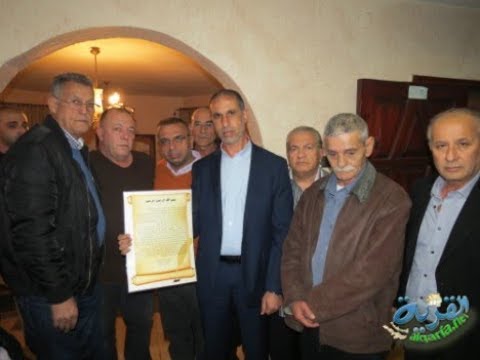
be held a religious ceremony besides the graves of the 49 victims of the massacre. Later, at a mass rally in the village's center, the mayor of Kufr-Qassem will present the three "Whistle Blowers" of the time, Latif Dori, Tawfiq Toubi and Meir Vilner the honorable freeman title of the village. Zarzur stressed that this was the first time in Israel's history that two Jews, Dori and Vilner, will become freemen of an Arab town or village. Latif Dori told the story of his revelation of the Kufr-Qassem blood bath, and its aftermath in court, as well of the shameful pardons and honors, the perpetrators of the crime received from the hands of the then ruling Labor establishment. Ali Zarzur, representing the bereaved families, told that he still has nightmares about the evening, when he was a 9-year old boy and his mother, pregnant in her eighth month, was killed by the trigger-happy soldiers. The chair of the Islamic Party in Israel, Sheik Abdullah Nimr Darwish, raised at the press conference his demand from the present government to hold - after 40 years delay - a "sulha", the traditional (Arab) reconciliation ceremony - not only with the inhabitants of Kufr-Qassem and the families of the victims, but also with the whole of the Palestinian people. Last not least, he said, the criminal massacre in Kufr-Qassem was only one stone in a mosaic of such crimes Israel has committed against the Palestinians. Apparently, the Ben-Gurion administration tried to repeat by it, what the Israeli forces under his command did in 1948, when they committed many such massacres in Dir-Yassin, Kufr Zeitun, and dozens of other Arab localities with the purpose to create a mass panic which, together with outright enforced expulsions, like in Lydda and Ramle (in these two towns alone of 50,000), created the still not solved problem of millions of Palestinian refugees and their offspring. But, in the case of Kufr-Qassem, as with the whole Arab population of Israel at the time, this design of repeating the creation of a panic did not succeed. "The refugees of 1948 and 1967, as all other Palestinians deported by Israel, have the legitimate right to return to their Palestinian homeland, he stressed. Until this right, laid down in international law and the special U.N.O. resolution, will be recognized and honored by Israel, there cannot be achieved any true and just peace here". He added that the Israelis should not fear the return of many of those refugees. When there will be peace between Israel and the future Palestinian state, the return of the Palestinians to their native homeland may become a blessing to all, the Israelis included. The press conference was chaired by the spokesman of the Committee, Uzi Burstein of the CP Israel. He expressed his hope that the commemoration day in Kufr-Qassem will achieve mass attention of Arab citizen as well as by many Jewish democrats. He announced that some important personalities from the PLO and the Palestinian PNA authority would take part, or at least broadcast in some way their greetings to the memorial ceremonies.
|